
Caldwell, Idaho Hail Report and Map: July 23, 2026
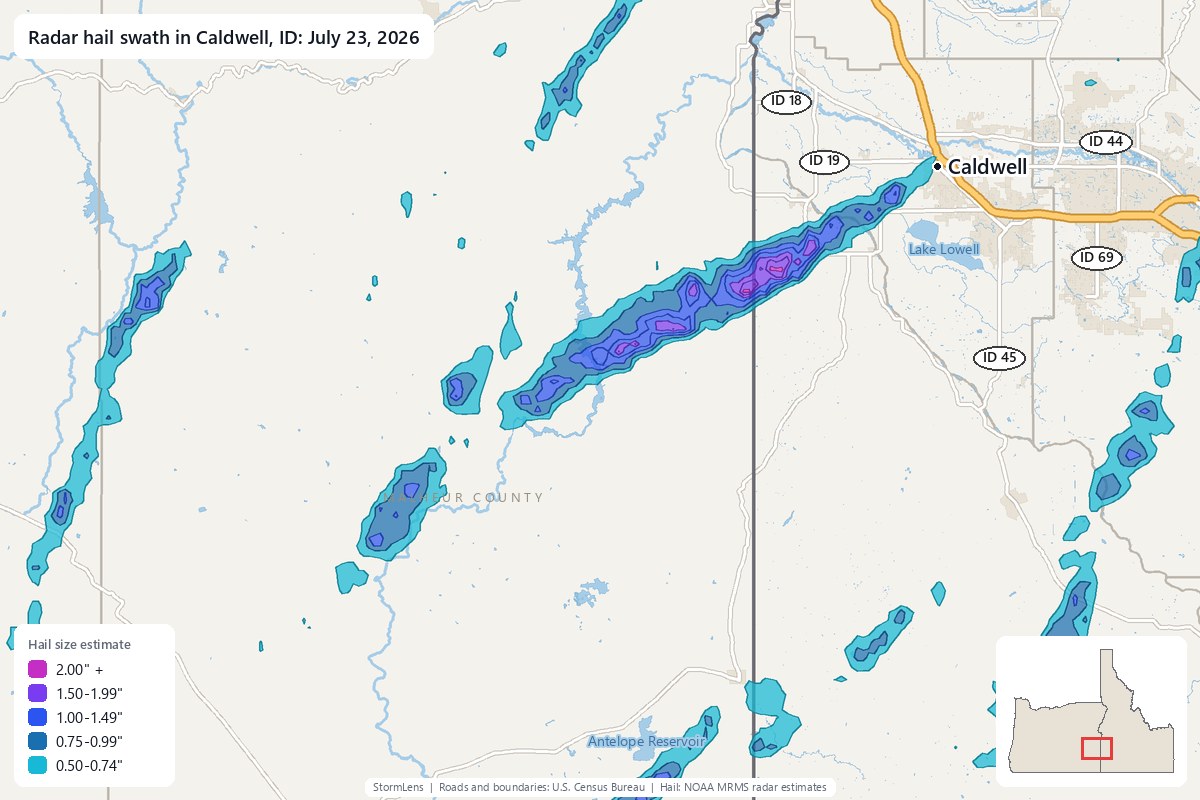
Was there hail in Caldwell, ID on July 23, 2026? Radar estimated hail up to 0.75 inch inside the town limits of Caldwell on July 23, 2026 (Eastern time). Radar estimates of at least 0.5 inch covered 9% of the town. Across the report area, the maximum radar estimate was 2.08 inches. The strongest part of the swath was about 18 miles southwest of Caldwell, ID.
Download the free app to view this hail swath and search an address.
Hail estimates at a glance
| Storm date (Eastern time) | July 23, 2026 (Thursday) |
|---|---|
| Maximum radar estimate across the area | 2.08 inches; strongest part of the swath about 18 miles southwest of Caldwell, ID |
| Maximum radar estimate inside Caldwell | 0.75 inch |
| Share of Caldwell with radar estimates of at least 0.5 inch | 9% |
| County coverage includes (0.5 inch or larger) | Malheur County (200 sq mi), Owyhee County (41 sq mi) and Canyon County (21 sq mi) |
| Area with radar estimates of 0.5 inch or larger | about 261 square miles |
| Area with radar estimates of 1 inch or larger | about 73 square miles |
| Source | NOAA MRMS radar hail estimates (MESH) |
Which towns had hail on July 23, 2026?
Radar estimated hail of at least 0.5 inch inside these town limits, using U.S. Census boundaries. Each percentage is the share of town area with those estimates.
| Town | County | Maximum radar estimate inside town limits | Town area with estimates of at least 0.5 inch |
|---|---|---|---|
| Caldwell, ID | Canyon County | 0.75 inch | 9% |
Data source and limits
We use NOAA's MRMS radar product MESH (Maximum Estimated Size of Hail) for hail-size estimates. Each town's figure is the maximum inside its Census town limits. The percentage is the town area with estimates of at least 0.5 inch. A town's maximum isn't an estimate for every home. Each storm date covers one calendar day in Eastern time. A late-evening storm west of the Eastern time zone can appear under two dates. Radar estimates don't confirm hail on the ground or roof damage. Hail of 0.5 to 0.75 inch can damage roofs, especially older roofs. An estimate below 1 inch doesn't rule out damage. Read how we calculate sizes and times.