
Lake Charles, Louisiana Hail Report and Map: July 1, 2026
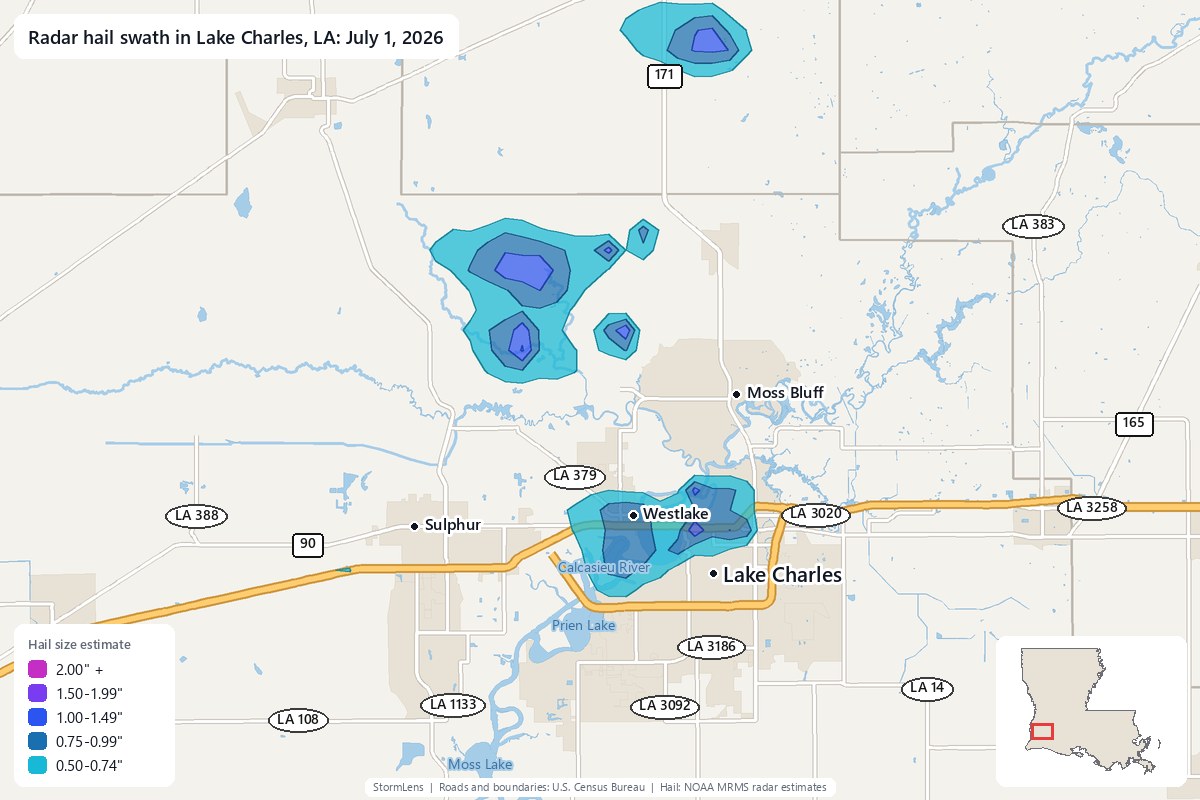
Was there hail in Lake Charles, LA on July 1, 2026? Radar estimated hail up to 1.2 inches inside the town limits of Lake Charles on July 1, 2026 (Eastern time). Radar estimates of at least 0.5 inch covered 21% of the town. Radar detected hail aloft in this area between about 3:45 p.m. and 4:25 p.m. CT on July 1, 2026.
Download the free app to view this hail swath and search an address.
Hail estimates at a glance
| Storm date (Eastern time) | July 1, 2026 (Wednesday) |
|---|---|
| Maximum radar estimate across the area | 1.28 inches; strongest part of the swath about 9 miles northwest of Lake Charles, LA |
| Maximum radar estimate inside Lake Charles | 1.2 inches |
| Share of Lake Charles with radar estimates of at least 0.5 inch | 21% |
| Approximate radar timing | Between about 3:45 p.m. and 4:25 p.m. CT on July 1, 2026 (Central time) |
| County coverage includes (0.5 inch or larger) | Calcasieu Parish (39 sq mi) |
| Area with radar estimates of 0.5 inch or larger | about 39 square miles |
| Area with radar estimates of 1 inch or larger | about 5 square miles |
| Source | NOAA MRMS radar hail estimates (MESH) |
Which towns had hail on July 1, 2026?
Radar estimated hail of at least 0.5 inch inside these town limits, using U.S. Census boundaries. Each percentage is the share of town area with those estimates.
| Town | County | Maximum radar estimate inside town limits | Town area with estimates of at least 0.5 inch |
|---|---|---|---|
| Lake Charles, LA | Calcasieu Parish | 1.2 inches | 21% |
| Westlake, LA | Calcasieu Parish | 0.92 inch | 39% |
Towns near the hail
The strongest part of the swath was within 15 miles of these towns. Distances and directions run from each town to that part of the swath.
- Moss Bluff, LA: strongest radar estimates about 6 miles northwest of town
- Sulphur, LA: strongest radar estimates about 9 miles northeast of town
What time did radar detect hail?
Radar detected hail aloft in this area between about 3:45 p.m. and 4:25 p.m. CT on July 1, 2026. We used 16 NOAA radar hail detections in this area to estimate the window. We trim outlying detection times when enough are available, then round down to five-minute marks. It doesn't give an arrival time at an address.
Data source and limits
We use NOAA's MRMS radar product MESH (Maximum Estimated Size of Hail) for hail-size estimates. Each town's figure is the maximum inside its Census town limits. The percentage is the town area with estimates of at least 0.5 inch. A town's maximum isn't an estimate for every home. Each storm date covers one calendar day in Eastern time. A late-evening storm west of the Eastern time zone can appear under two dates. Radar estimates don't confirm hail on the ground or roof damage. Hail of 0.5 to 0.75 inch can damage roofs, especially older roofs. An estimate below 1 inch doesn't rule out damage. Read how we calculate sizes and times.
Other hail reports for July 1, 2026
- Hail in Sheboygan, WI: up to 2.57 inches
- Hail in Albertville, AL: up to 2.56 inches
- Hail in Huntsville, AL: up to 1.23 inches
- Hail in South Fulton, GA: up to 1.28 inches
- Hail in Amarillo, TX: up to 1.24 inches
- Hail in Schenectady, NY: up to 1.11 inches
- Hail in Birmingham, AL: up to 1.38 inches
- Hail near Rapid City, SD: up to 1.37 inches
- Hail near Starkville, MS: up to 1.35 inches
- Hail near Glenville, NY: up to 1.57 inches
- Hail near Homestead, FL: up to 1.33 inches