
Duncan, Oklahoma Hail Report and Map: March 29, 2025
Was there hail in Duncan, OK on March 29, 2025? Radar estimated hail up to 2.14 inches inside the town limits of Duncan on March 29, 2025 (Eastern time). Radar estimates of at least 0.5 inch covered 81% of the town. Across the report area, the maximum radar estimate was 2.41 inches. The strongest part of the swath was about 63 miles south of Oklahoma City, OK. Radar detected hail aloft in this area between about 8:15 p.m. and 10:50 p.m. CT on March 29, 2025.
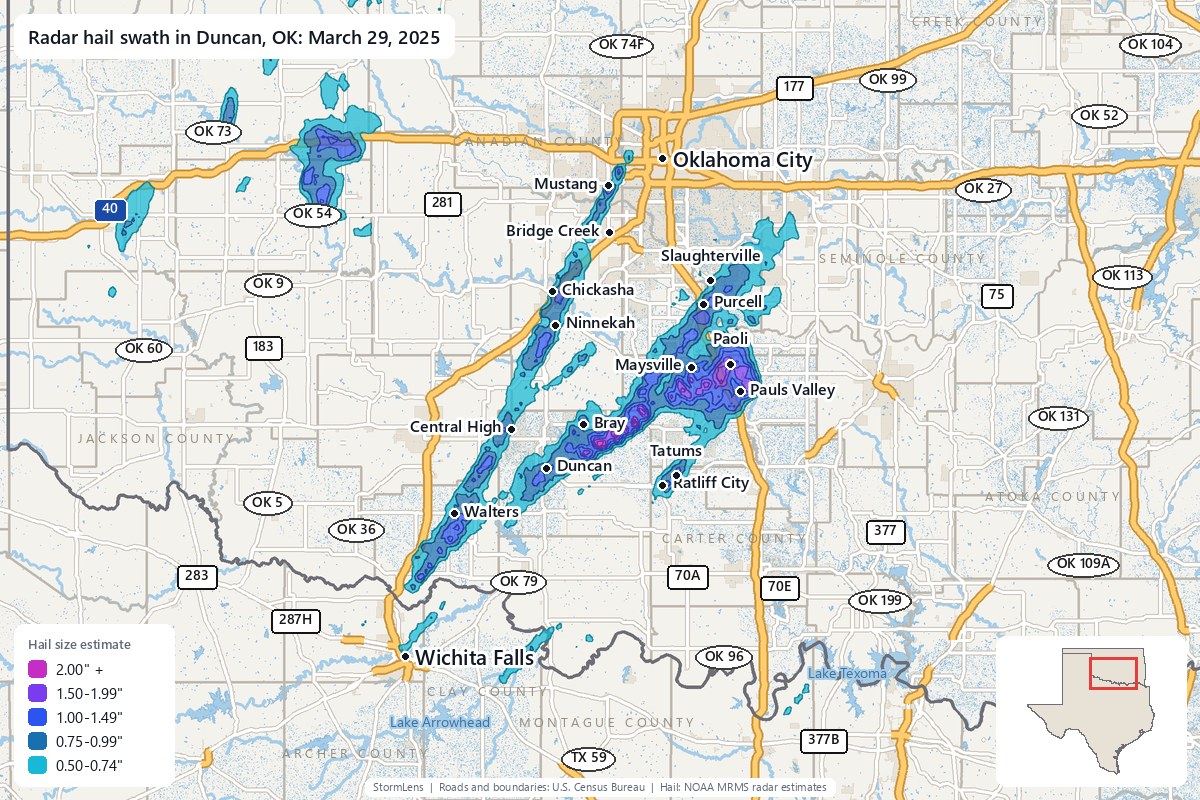
Download the free app to view this hail swath and search an address.
Need the hail history for one address? Get a free storm report. You can also read about hail history by address and storm reports for roofers, or open the free hail map.
Hail estimates at a glance
| Storm date (Eastern time) | March 29, 2025 (Saturday) |
|---|---|
| Maximum radar estimate across the area | 2.41 inches; strongest part of the swath about 63 miles south of Oklahoma City, OK |
| Maximum radar estimate inside Duncan | 2.14 inches |
| Share of Duncan with radar estimates of at least 0.5 inch | 81% |
| Approximate radar timing | Between about 8:15 p.m. and 10:50 p.m. CT on March 29, 2025 (Central time) |
| County coverage includes (0.5 inch or larger) | Garvin County (385 sq mi), Stephens County (291 sq mi), Grady County (239 sq mi), Cotton County (173 sq mi), Cleveland County (143 sq mi) and McClain County (141 sq mi) |
| Area with radar estimates of 0.5 inch or larger | about 1,537 square miles |
| Area with radar estimates of 1 inch or larger | about 328 square miles |
| Source | NOAA MRMS radar hail estimates (MESH) |
Which towns had hail on March 29, 2025?
Radar estimated hail of at least 0.5 inch inside these town limits, using U.S. Census boundaries. Each percentage is the share of town area with those estimates.
| Town | County | Maximum radar estimate inside town limits | Town area with estimates of at least 0.5 inch |
|---|---|---|---|
| Duncan, OK | Stephens County | 2.14 inches | 81% |
| Bray, OK | Stephens County | 2.04 inches | 82% |
| Paoli, OK | Garvin County | 1.71 inches | 100% |
| Pauls Valley, OK | Garvin County | 1.37 inches | 92% |
| Purcell, OK | McClain County | 1.23 inches | 52% |
| Empire City, OK | Stephens County | 1.22 inches | 55% |
| Oklahoma City, OK | Oklahoma County | 1.2 inches | 3% |
| Mustang, OK | Canadian County | 1.17 inches | 45% |
| Maysville, OK | Garvin County | 1.17 inches | 100% |
| Lexington, OK | Cleveland County | 1.14 inches | 100% |
| Slaughterville, OK | Cleveland County | 1.06 inches | 82% |
| Central High, OK | Stephens County | 1.06 inches | 50% |
| Tuttle, OK | Grady County | 1.05 inches | 37% |
| Chickasha, OK | Grady County | 1.04 inches | 44% |
| Walters, OK | Cotton County | 0.98 inch | 33% |
| Ninnekah, OK | Grady County | 0.98 inch | 94% |
| Tatums, OK | 0.98 inch | 100% | |
| Ratliff City, OK | 0.81 inch | 100% | |
| Bridge Creek, OK | 0.77 inch | 6% | |
| Wichita Falls, TX | Wichita County | 0.75 inch | 2% |
How big was the hail in Duncan?
Radar estimated hail up to 2.14 inches inside the town limits of Duncan. The maximum estimates in Oklahoma City, Wichita Falls and Mustang were 1.2 inches or less. A town's maximum isn't an estimate for every home. Check the swath for estimates around an address.
What time did radar detect hail?
Radar detected hail aloft in this area between about 8:15 p.m. and 10:50 p.m. CT on March 29, 2025. We used 281 NOAA radar hail detections in this area to estimate the window. We trim outlying detection times when enough are available, then round down to five-minute marks. It doesn't give an arrival time at an address.
Data source and limits
We use NOAA's MRMS radar product MESH (Maximum Estimated Size of Hail) for hail-size estimates. Each town's figure is the maximum inside its Census town limits. The percentage is the town area with estimates of at least 0.5 inch. A town's maximum isn't an estimate for every home. Each storm date covers one calendar day in Eastern time. A late-evening storm west of the Eastern time zone can appear under two dates. Radar estimates don't confirm hail on the ground or roof damage. Hail of 0.5 to 0.75 inch can damage roofs, especially older roofs. Read how we calculate sizes and times.