
Fort Worth, Texas Hail Report and Map: October 10, 2021
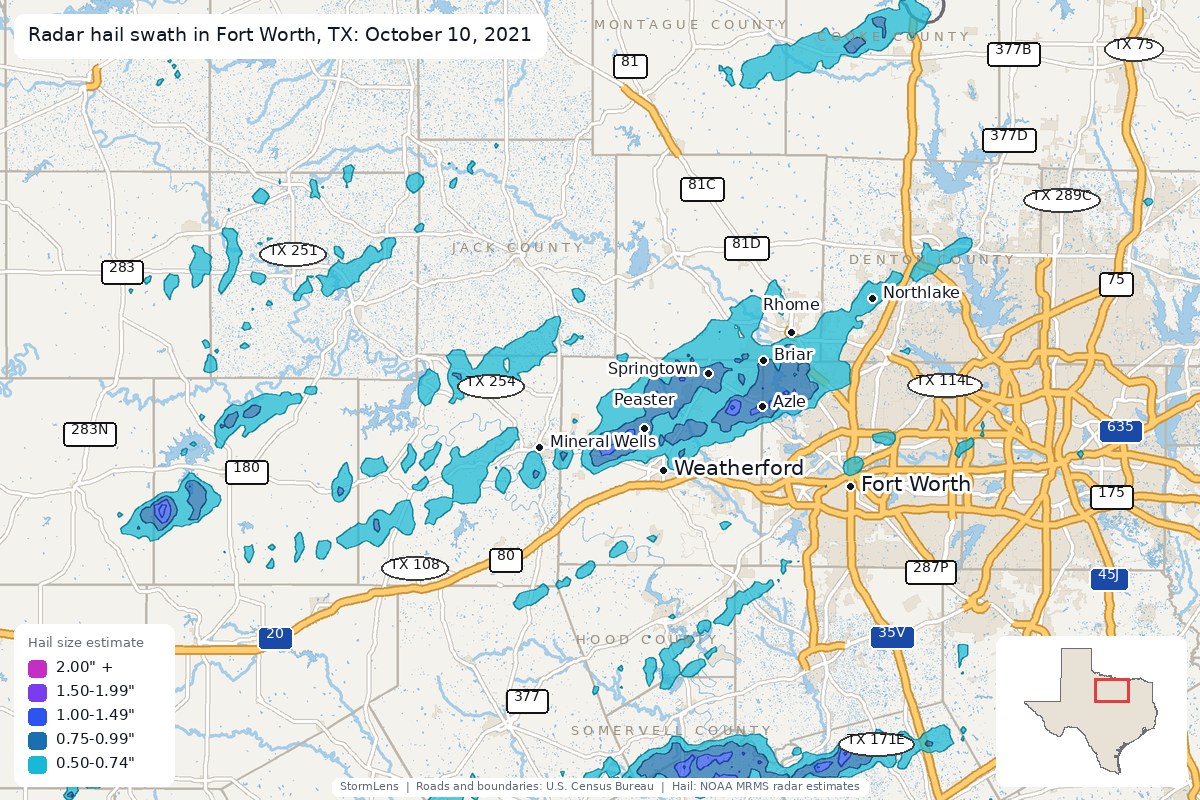
Was there hail in Fort Worth, TX on October 10, 2021? Radar estimated hail up to 0.93 inch inside the town limits of Fort Worth on October 10, 2021 (Eastern time). Radar estimates of at least 0.5 inch covered 6% of the town. Across the report area, the maximum radar estimate was 1.35 inches. The strongest part of the swath was about 23 miles northwest of Fort Worth, TX. Radar detected hail aloft in this area between about 8:10 p.m. and 9:25 p.m. CT on October 10, 2021.
Download the free app to view this hail swath and search an address.
Need the hail history for one address? Get a free storm report. You can also read about hail history by address and storm reports for roofers, or open the free hail map.
Hail estimates at a glance
| Storm date (Eastern time) | October 10, 2021 (Sunday) |
|---|---|
| Maximum radar estimate across the area | 1.35 inches; strongest part of the swath about 23 miles northwest of Fort Worth, TX |
| Maximum radar estimate inside Fort Worth | 0.93 inch |
| Share of Fort Worth with radar estimates of at least 0.5 inch | 6% |
| Approximate radar timing | Between about 8:10 p.m. and 9:25 p.m. CT on October 10, 2021 (Central time) |
| County coverage includes (0.5 inch or larger) | Parker County (310 sq mi), Palo Pinto County (184 sq mi), Wise County (114 sq mi), Tarrant County (83 sq mi), Denton County (75 sq mi) and Jack County (39 sq mi) |
| Area with radar estimates of 0.5 inch or larger | about 828 square miles |
| Area with radar estimates of 1 inch or larger | about 18 square miles |
| Source | NOAA MRMS radar hail estimates (MESH) |
Which towns had hail on October 10, 2021?
Radar estimated hail of at least 0.5 inch inside these town limits, using U.S. Census boundaries. Each percentage is the share of town area with those estimates.
| Town | County | Maximum radar estimate inside town limits | Town area with estimates of at least 0.5 inch |
|---|---|---|---|
| Azle, TX | Tarrant County | 1.07 inches | 97% |
| Peaster, TX | 1.04 inches | 100% | |
| Briar, TX | Wise County | 1.01 inches | 100% |
| Reno, TX | Parker County | 1 inch | 100% |
| Pecan Acres, TX | Tarrant County | 0.99 inch | 100% |
| Fort Worth, TX | Tarrant County | 0.93 inch | 6% |
| Carter, TX | 0.93 inch | 97% | |
| Pelican Bay, TX | Tarrant County | 0.91 inch | 100% |
| Springtown, TX | Parker County | 0.89 inch | 100% |
| Sanctuary, TX | 0.87 inch | 100% | |
| Newark, TX | Wise County | 0.83 inch | 100% |
| Rhome, TX | Wise County | 0.81 inch | 32% |
| Mineral Wells, TX | Palo Pinto County | 0.79 inch | 26% |
| Garner, TX | 0.77 inch | 56% | |
| Northlake, TX | Denton County | 0.75 inch | 24% |
How big was the hail in Fort Worth?
Radar estimated hail up to 0.93 inch inside the town limits of Fort Worth. Among the listed towns, the highest estimate was 1.07 inches inside the limits of Azle. A town's maximum isn't an estimate for every home. Check the swath for estimates around an address.
Towns near the hail
The strongest part of the swath was within 15 miles of these towns. Distances and directions run from each town to that part of the swath.
- Weatherford, TX: strongest radar estimates about 11 miles northeast of town
What time did radar detect hail?
Radar detected hail aloft in this area between about 8:10 p.m. and 9:25 p.m. CT on October 10, 2021. We used 110 NOAA radar hail detections in this area to estimate the window. We trim outlying detection times when enough are available, then round down to five-minute marks. It doesn't give an arrival time at an address.
Data source and limits
We use NOAA's MRMS radar product MESH (Maximum Estimated Size of Hail) for hail-size estimates. Each town's figure is the maximum inside its Census town limits. The percentage is the town area with estimates of at least 0.5 inch. A town's maximum isn't an estimate for every home. Each storm date covers one calendar day in Eastern time. A late-evening storm west of the Eastern time zone can appear under two dates. Radar estimates don't confirm hail on the ground or roof damage. Hail of 0.5 to 0.75 inch can damage roofs, especially older roofs. Read how we calculate sizes and times.