
Gadsden, Alabama Hail Report and Map: July 2, 2026
Was there hail in Gadsden, AL on July 2, 2026? Radar estimated hail up to 0.78 inch inside the town limits of Gadsden on July 2, 2026 (Eastern time). Radar estimates of at least 0.5 inch covered 16% of the town. Across the report area, the maximum radar estimate was 1.98 inches. The strongest part of the swath was about 25 miles southeast of Gadsden, AL. Radar detected hail aloft in this area between about 3:10 p.m. and 9:35 p.m. CT on July 2, 2026.
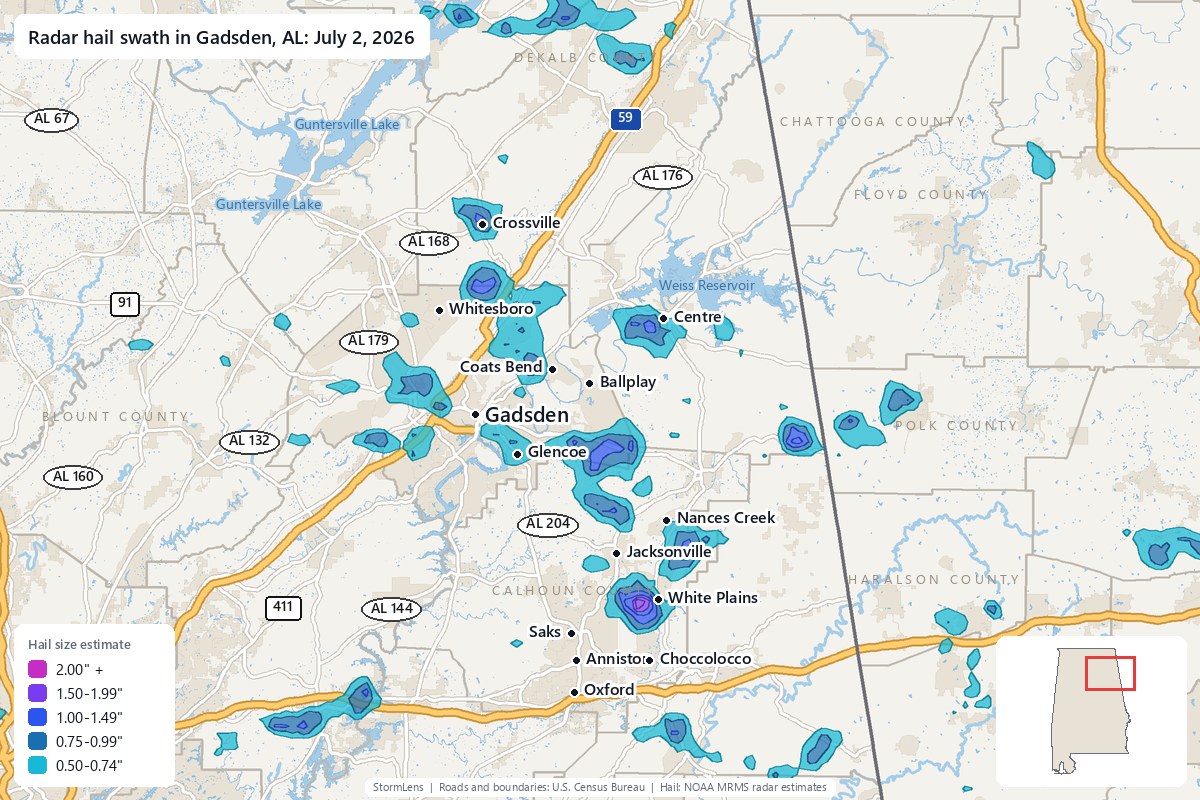
Download the free app to view this hail swath and search an address.
Hail estimates at a glance
| Storm date (Eastern time) | July 2, 2026 (Thursday) |
|---|---|
| Maximum radar estimate across the area | 1.98 inches; strongest part of the swath about 25 miles southeast of Gadsden, AL |
| Maximum radar estimate inside Gadsden | 0.78 inch |
| Share of Gadsden with radar estimates of at least 0.5 inch | 16% |
| Approximate radar timing | Between about 3:10 p.m. and 9:35 p.m. CT on July 2, 2026 (Central time) |
| County coverage includes (0.5 inch or larger) | Etowah County (85 sq mi), Calhoun County (76 sq mi), Cherokee County (35 sq mi), DeKalb County (27 sq mi) and Cleburne County (4 sq mi) |
| Area with radar estimates of 0.5 inch or larger | about 223 square miles |
| Area with radar estimates of 1 inch or larger | about 24 square miles |
| Source | NOAA MRMS radar hail estimates (MESH) |
Which towns had hail on July 2, 2026?
Radar estimated hail of at least 0.5 inch inside these town limits, using U.S. Census boundaries. Each percentage is the share of town area with those estimates.
| Town | County | Maximum radar estimate inside town limits | Town area with estimates of at least 0.5 inch |
|---|---|---|---|
| White Plains, AL | Calhoun County | 1.98 inches | 64% |
| Centre, AL | Cherokee County | 1.2 inches | 57% |
| Ballplay, AL | Etowah County | 1.15 inches | 31% |
| Crossville, AL | DeKalb County | 1.07 inches | 55% |
| Hokes Bluff, AL | Etowah County | 1.06 inches | 39% |
| Whitesboro, AL | Etowah County | 0.98 inch | 9% |
| Coats Bend, AL | 0.93 inch | 38% | |
| Lookout Mountain, AL | 0.8 inch | 54% | |
| Gadsden, AL | Etowah County | 0.78 inch | 16% |
| Glencoe, AL | Etowah County | 0.78 inch | 32% |
| Jacksonville, AL | Calhoun County | 0.76 inch | 17% |
How big was the hail in Gadsden?
Radar estimated hail up to 0.78 inch inside the town limits of Gadsden. Among the listed towns, the highest estimate was 1.98 inches inside the limits of White Plains. The maximum estimates in Jacksonville, Glencoe and Hokes Bluff were 1.06 inches or less. A town's maximum isn't an estimate for every home. Check the swath for estimates around an address.
Towns near the hail
The strongest part of the swath was within 15 miles of these towns. Distances and directions run from each town to that part of the swath.
- Saks, AL: strongest radar estimates about 8 miles northeast of town
- Anniston, AL: strongest radar estimates about 9 miles northeast of town
- Oxford, AL: strongest radar estimates about 11 miles northeast of town
What time did radar detect hail?
Radar detected hail aloft in this area between about 3:10 p.m. and 9:35 p.m. CT on July 2, 2026. We used 232 NOAA radar hail detections in this area to estimate the window. We trim outlying detection times when enough are available, then round down to five-minute marks. It doesn't give an arrival time at an address.
This report shares at least one town with the report for July 1, 2026. Storm dates run from midnight to midnight Eastern time, so a late-evening storm farther west can appear under two dates. See the Albertville, AL report for July 1, 2026.
Data source and limits
We use NOAA's MRMS radar product MESH (Maximum Estimated Size of Hail) for hail-size estimates. Each town's figure is the maximum inside its Census town limits. The percentage is the town area with estimates of at least 0.5 inch. A town's maximum isn't an estimate for every home. Each storm date covers one calendar day in Eastern time. A late-evening storm west of the Eastern time zone can appear under two dates. Radar estimates don't confirm hail on the ground or roof damage. Hail of 0.5 to 0.75 inch can damage roofs, especially older roofs. An estimate below 1 inch doesn't rule out damage. Read how we calculate sizes and times.
Other hail reports for July 2, 2026
- Hail in West Des Moines, IA: up to 2.17 inches
- Hail in Aurora, IL: up to 1.19 inches
- Hail in Clarksville, TN: up to 2.16 inches
- Hail in Huron, SD: up to 2.79 inches
- Hail in Greeley, CO: up to 1.77 inches
- Hail in Greenville, SC: up to 1.48 inches
- Hail in Nolensville, TN: up to 1.51 inches
- Hail in Fremont, NE: up to 1.66 inches
- Hail in Sioux City, IA: up to 1.79 inches
- Hail in Fort Myers, FL: up to 1.25 inches
- Hail in Germantown, WI: up to 1.39 inches
- Hail in Fairview, TN: up to 1.38 inches
- Hail near Dalton, GA: up to 1.48 inches